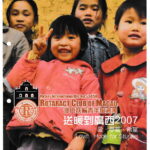
A Ten-Year Record of the Rotary Club of Kowloon North, Hong Kong and the Rotary Club of Macau Supporting Ethnic Education in Du’an County, Guangxi
1999–2009
Eternal Love, Everlasting Friendship
Contents
Preface
Foreword
Introduction to Education in Du’an
Inscriptions
Thank-you Letter
Past Rotary Presidents and Honorary Principals
Hearts with the Yao Mountains
An Eternal Monument
Endless Compassion
Conclusion
Preface
We have always believed that there must be a fitting way to remember these people, these deeds, and this love. When Mr. Lan Qinwen and the past presidents of the Rotary Clubs of Hong Kong and Macau, including Mr. Choi Sai Hong, Mr. Bill Benter, and Ms. Jian Peiwen, came to Du’an through summer heat and winter cold; when groups of compatriots from Hong Kong and Macau travelled far to the Yao mountains; and when new teaching buildings rose one after another on school campuses, we believed—and our children believed—that these people, deeds, and acts of love had taken deep root in our hearts.
Therefore, in the name of love, we have compiled this pictorial record. Through photographs, reflection, and gratitude, we record this kindness forever.
Du’an is far from Hong Kong and Macau, yet all Chinese people share common roots, and blood is thicker than water. Du’an came into the view of Hong Kong and Macau because of poverty and backwardness, and because the Rotary Clubs of Hong Kong and Macau searched for places where their love could help. We cannot forget the figures of Rotary volunteers travelling through Du’an’s countless mountains and valleys, nor the sweat they shed in Yao mountain schools. We cannot forget the years 1999, 2000, 2002, and 2004, nor the figures 500,000, 1,453,569, 1,500,000, and 5,960,000 yuan, which represent generosity and practical support. Behind the improved facilities and learning environments of Du’an Ethnic Experimental Middle School and the schools at Nongyan, Banlie, Yongping, Yanma, Jianqiao, Longzhong, Hualai, and other places lies the great contribution of caring people from Hong Kong and Macau.
There is great beauty in the world, and true love is remembered among people. With grateful hearts, we have done what we most needed to do. Over the past ten years, with the help of the Rotary Clubs of Hong Kong and Macau and many charitable organizations, and with government investment of more than RMB 200 million, primary and secondary schools throughout the county have been renovated and rebuilt, and school infrastructure has been greatly improved. We have worked to raise the standard of education across the county, strengthened teacher training, and introduced new teaching methods. As a result, Du’an’s primary, junior secondary, and senior secondary education has ranked among the best in Hechi City, writing a proud chapter in the story of a poor county running a strong education system. In 2007, Du’an successfully passed autonomous-region and national assessments for the “Two Basics”: basically universalizing nine-year compulsory education and basically eliminating illiteracy among young and middle-aged adults. Du’an’s educational infrastructure finally parted from its backward past.
We remember Ms. Jian Peiwen’s words: “The Mainland, Hong Kong, and Macau are one family. We do not consider the job complete after building a school; we want this love for education to continue.” We believe that the selfless dedication of the Rotary Clubs of Hong Kong and Macau will help our children better understand what love is and learn how to love. As we look back on ten years of help from the Rotary Clubs of Hong Kong and Macau, we should not only remember this deep love, but also carry it forward. Each of us has both the wish and the responsibility to do so.
Huang Hanying and Wei Shaoshi
May 2009
Foreword
Rotary International is an international civil society service organization. It was founded in Chicago in February 1905 by the American lawyer Paul P. Harris. At first, the principle was to admit one member from each occupation in the local community. Meetings rotated among members’ offices, which gave the organization its name. The International Association of Rotary Clubs was formed in 1910, followed by the International Association of Rotary Clubs in 1912; in 1922 it became Rotary International.
Rotary’s stated purpose is to encourage the ideal of service as the basis of worthwhile enterprise, and in particular to promote international understanding, goodwill, and peace. Rotary’s ideals reached Hong Kong and Macau in the 1930s. Over the decades, the Rotary Clubs of Hong Kong and Macau have not only served their local communities, but have also actively participated in international relief and poverty-alleviation work in mainland China, with particular concern for education in poor minority regions.
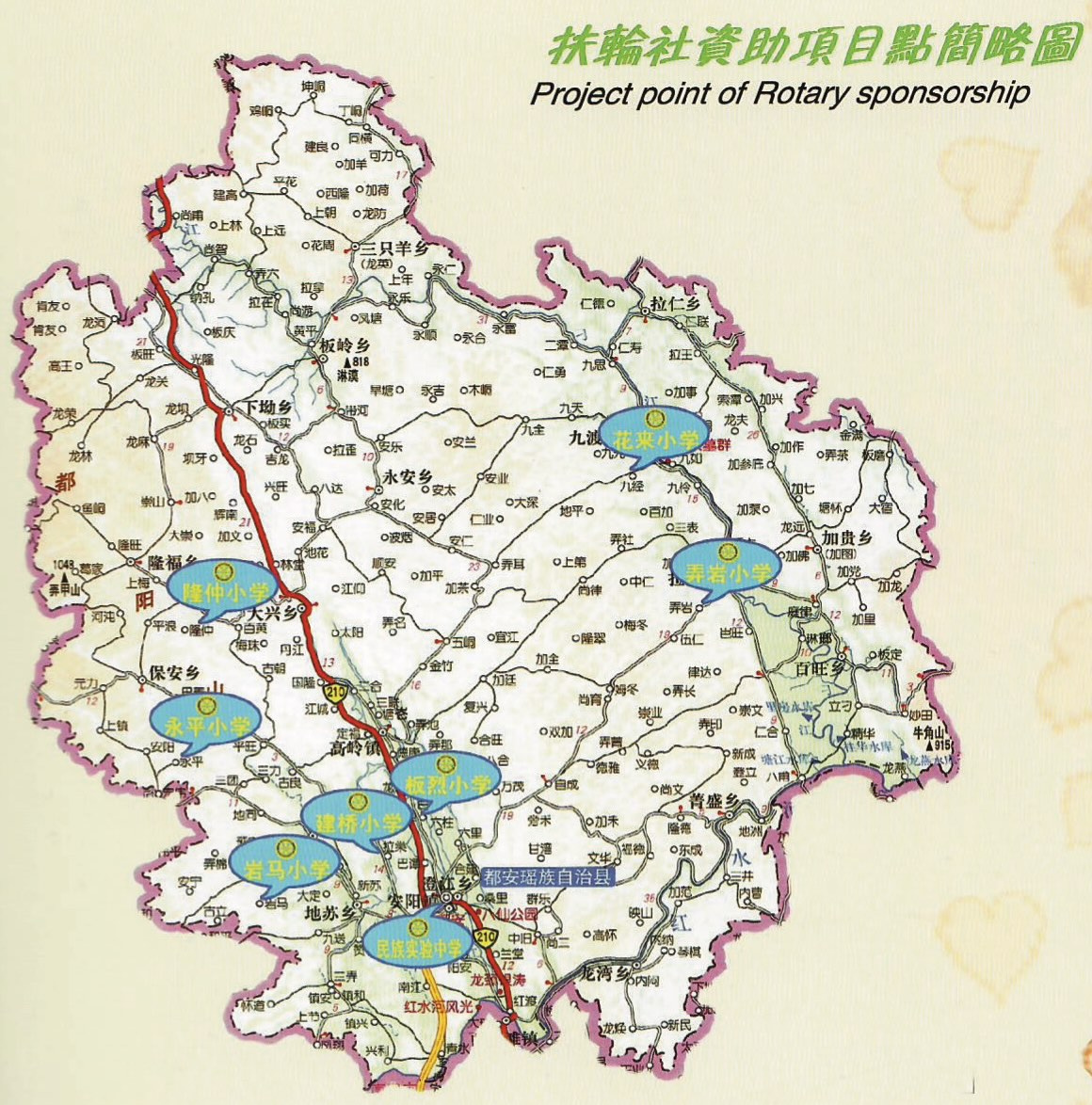
Since 1999, successive presidents and members of the Rotary Club of Kowloon North and the Rotary Club of Macau have raised and donated significant funds to support education in Du’an County. They helped build Du’an Ethnic Experimental Middle School and seven village-level primary schools in remote mountain areas: Nongyan, Yongping, Banlie, Yanma, Jianqiao, Longzhong, and Hualai. Through Rotary’s love and service, a new chapter was opened in basic education in poor mountain villages, and Du’an Ethnic Experimental Middle School gained a rare opportunity for development.
The Rotary Club of Kowloon North and the Rotary Club of Macau began their educational support in Du’an in 1999. In October of that year, Mr. Choi Sai Hong, past president of the Rotary Club of Macau, attended the completion ceremony of Xingli Primary School in Sannong Township, a project supported by the Rotary Club of Guia, Macau, and made an initial survey of education in the county. After returning to Macau, he joined the Rotary Club of Kowloon North in making another visit to Du’an in early 2000. They travelled tirelessly through poor villages and were deeply moved by the dangerous classrooms and difficult conditions faced by teachers and students.
From that year onward, the two clubs mobilized members and donated RMB 1,453,569 to rebuild Nongyan Primary School in Lalie Township, Yongping Primary School and Longzhong Primary School in Bao’an Township, Banlie Primary School in Gaoling Town, Yanma Primary School in Dongmiao Township, Jianqiao Primary School in Disu Township, and Hualai Primary School in Jiudu Township. Except for Banlie and Jianqiao, the other five primary schools were located in remote Yao mountain areas. In addition to reinforced-concrete teaching buildings able to accommodate six classes, most of the rebuilt schools were also equipped with teacher and student dormitories, canteens, playgrounds, walls, water tanks, school gates, toilets, desks, chairs, bunk beds, and mosquito nets. They became among the best-equipped village primary schools in Du’an and met the requirements of the national “Two Basics” programme.
Du’an Ethnic Experimental Middle School was founded in 1990 and later designated as an experimental base for junior secondary education reform in the county. Because of financial difficulties, the school’s facilities were extremely poor. After learning of the situation, the Rotary Club of Kowloon North and the Rotary Club of Macau made three detailed inspections and decided to fund hardware projects in phases. Phase I, costing RMB 1.5 million, began at the end of 2001 and included a 2,350-square-metre student dormitory, continuation and renovation of a teaching complex of more than 3,900 square metres, and the filling of a waste pond to create a sports ground. Phase II, with donations of RMB 2.942 million, included a 3,936-square-metre science and technology laboratory building, expansion of teaching buildings and toilets, renovation of the southern teaching building, expansion and renovation of an 820-square-metre student canteen, and improvement of sports grounds and landscaping.
The two Rotary Clubs also provided a multimedia classroom for the Ethnic Experimental Middle School, desks and chairs for Sanlian and Fumin Primary Schools, health checks for primary and secondary students, a clinic for the county kindergarten, scholarships, assistance for poor students, school exchanges between Hong Kong, Macau, and Du’an, and support for sheep-raising households in Xingli Village, Sannong Township.
Today, the primary and secondary schools supported by the Rotary Clubs of Hong Kong and Macau have seen great improvements in teaching quality and in the all-round development of students. Each year they send many qualified and outstanding graduates to higher-level schools.
Introduction to Education in Du’an
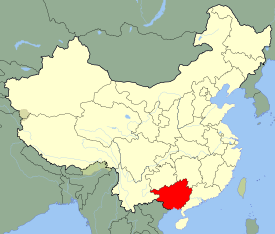
Du’an Yao Autonomous County is located in the central-western part of Guangxi. It covers 4,095 square kilometres and has 450,000 mu of arable land. It is a mountainous county often described as “nine parts stone and one part soil.” The county has two towns, seventeen townships, 248 administrative villages and neighbourhood committees, and 7,201 village groups. Its population is about 660,000, of whom 97.14 percent are ethnic minorities and 22.1 percent are Yao. Because of harsh natural conditions, slow economic development, and long-term underinvestment in minority education, Du’an is a national key poverty-alleviation county.
The county has 876 schools and teaching sites: 248 village primary schools and 565 teaching points with 65,925 students; 24 junior secondary schools with 24,307 students; three senior secondary schools with 10,781 students; one vocational education centre with 1,980 students; one county kindergarten with 700 students; and 33 private kindergartens with 2,133 students. There are 5,822 teaching and administrative staff, including 3,769 full-time primary teachers, 1,264 junior secondary teachers, and 617 senior secondary teachers.
In recent years, Du’an has placed education in a strategic priority position and vigorously implemented the strategies of developing the county through science and education and strengthening the county through talent. Education across the county has developed in a sustained, healthy, and coordinated way.
The “Two Basics” campaign achieved a decisive victory and greatly improved school conditions. From 2004 to 2007, in accordance with national policy, the county invested RMB 169 million in school infrastructure to basically universalize nine-year compulsory education and basically eliminate illiteracy among young and middle-aged adults. In December 2006 and June 2007, Du’an’s “Two Basics” work passed autonomous-region and national inspections. The support of all levels of leadership, the people of all ethnic groups in the county, charitable organizations at home and abroad, and all sectors of society was essential. In particular, the Rotary Club of Kowloon North and the Rotary Club of Macau donated more than RMB 10 million to support the Ethnic Experimental Middle School and the primary schools of Nongyan, Banlie, Yongping, Yanma, Jianqiao, Longzhong, and Hualai. Their contribution played an important role in the county’s success. In the rural villages of Du’an’s rocky mountains, the most beautiful buildings are now schools, and the brightest sight is the five-star red flag flying above them.
The development of ordinary senior secondary education has accelerated. The county has one autonomous-region model senior secondary school and two first-grade senior secondary schools. College entrance examination results have improved year after year. Since the restoration of the national college entrance examination, more than 50,000 students from Du’an have entered colleges and universities, and 63 have entered Peking University or Tsinghua University. Du’an has achieved the distinction of sending students to those two universities for nineteen consecutive years. Educational indicators have remained among the best in Hechi City.
Vocational education has also developed well. In 2007, the county integrated its vocational education resources and established a vocational education centre, greatly strengthening vocational education and working toward becoming an autonomous-region model vocational education centre.
The teaching force has been further strengthened. Since 2003, the county has recruited 1,246 outstanding university graduates through public recruitment, gradually solving the problem of substitute teachers. In 2006, a long-term teacher-management and incentive mechanism was established. Teachers in the county have won 60 national, 200 autonomous-region, and 410 city-level awards in quality-class and paper competitions.
School infrastructure has been significantly improved. Since 2003, the county has implemented 933 school construction projects, invested RMB 169 million, and built 194,878.28 square metres of school buildings. The national modern distance-education project for rural primary and secondary schools invested RMB 12.567 million and equipped schools with 169 sets of “Mode 1,” 224 sets of “Mode 2,” and 29 sets of “Mode 3.” The county-based management system for compulsory education has been established and improved, and funding reforms have further guaranteed the sustained development of compulsory education.
Nevertheless, because Du’an is a poor county with a large education system, the foundation for educational development remains weak. Rural education is still comparatively fragile, and the county’s primary and secondary schools still have 24,942 square metres of dangerous buildings, accounting for 4.9 percent of total school building area.
The Eleventh Five-Year Plan period is important for Du’an’s educational development. Facing new situations, opportunities, and challenges, Du’an must guide its work through the scientific outlook on development, consolidate and improve the achievements of the “Two Basics,” vigorously develop vocational education, and strengthen ordinary senior secondary education. The county will work to provide education that satisfies the people, with new concepts in teaching, new ideas for safe and harmonious campuses, new measures in management, new improvements in school conditions, and new gains in educational quality.
We firmly believe that, under the leadership of the county Party committee, the county government, and higher education authorities, and with the support of the people of all ethnic groups, all sectors of society, the Rotary Clubs of Hong Kong and Macau, and charitable organizations at home and abroad, education in Du’an will have an even brighter future.
Inscriptions
Huang Hanying, Secretary of the Du’an County Party Committee:
“Educational donations bring merit for generations.”
Wei Shaoshi, Head of Du’an County:
“Love nourishes the Yao mountains; students bloom like peaches and plums.”
Bill Benter, former president of the Rotary Club of Kowloon North, offered words of encouragement and appreciation.
Jian Peiwen, former president of the Rotary Club of Macau, also offered an inscription of love and support.
Thank-you Letter
To the distinguished presidents and members of the Rotary Club of Kowloon North, Hong Kong, and the Rotary Club of Macau:
For many years, your hearts have been with Du’an Yao Autonomous County in Guangxi. You have generously donated more than RMB 10 million to build Du’an Ethnic Experimental Middle School and the eight primary and secondary schools at Nongyan, Yongping, Longzhong, Banlie, Yanma, Jianqiao, and Hualai. You have gradually improved school conditions in the Yao mountains and enabled many poor students to return to school and complete their studies. Campuses have changed; reading voices fill the school gates; green grounds and blooming flowers surround dedicated teachers who nurture future talent. New buildings, bright classrooms, and the fragrance of books have helped countless students strive toward success. The care of the two Rotary Clubs has become nourishing rain for Zhuang and Yao villages and has raised an enduring monument of love in local schools.
On behalf of the county’s 100,000 primary and secondary students and 660,000 people of all ethnic groups, we express heartfelt thanks and highest respect to all presidents and members who have cared for and supported education in Du’an Yao Autonomous County.
The two Rotary Clubs’ good deeds in poverty relief, educational support, and school construction will be remembered for generations. Du’an Yao Autonomous County lies in a rocky mountain area and is a minority region and national key poverty-alleviation county. Because of harsh natural conditions, lagging economic development, poor infrastructure, widespread rural poverty, and backward educational facilities, much remains to be done and the quality of the workforce must be raised. The struggle has not ended, and a better life must continue to be built.
We sincerely hope that compatriots from Hong Kong, Macau, and Taiwan, overseas Chinese, and international friends will continue to support Du’an’s economic development and social progress. Let us join hands and hearts to build a prosperous, cultured, ecological, and peaceful Du’an.
True feeling is boundless, love is eternal; outstanding achievements will stand forever.
May all presidents and members enjoy good fortune, happiness, and good health.
The People’s Government of Du’an Yao Autonomous County
May 2009
Past Rotary Presidents and Honorary Principals
Rotary Club of Kowloon North, 1999–2009:
Bruce Stinson, President 1999–2000
Bill Benter, President 2000–2001
David Lindsay, President 2001–2002
David Lindsay, President 2002–2003
Nic Robinson, President 2003–2004
Ian Petersen, President 2004–2005
Howard Davies, President 2005–2006
Maurine Boost, President 2006–2007
Angela Wong, President 2007–2008
David Wright, President 2008–2009
Rotary Club of Macau, 1999–2009:
Edmund Ho, Chief Executive of the Macau Special Administrative Region and honorary president
Jian Peiwen, former president and honorary principal of Du’an Ethnic Experimental Middle School
Sai-Hong Choi, President 1999–2000
Jim O’Mullan, President 2000–2001
Alfredo Ritchie, President 2001–2002
Pui-Fai Ip, President 2002–2003
Synthia Chan, President 2003–2004
Fatima Ferreira, President 2004–2005
Kazuyoshi Noguchi, President 2005–2006
Keith Pharis, President 2006–2007
Filipe Senna Fernandes, President 2007–2008
Florence Hui, President 2008–2009
Hearts with the Yao Mountains
Du’an lies in a rocky mountain region with harsh natural conditions and is one of China’s poorest counties. Because of financial constraints and long-term underinvestment in minority education, many village primary and secondary schools had dilapidated buildings, and some classrooms were dangerous. The poverty of Du’an and the backwardness of its ethnic education drew the attention of compatriots from Hong Kong and Macau and people from all walks of life.
After the June 13 flood in 1994, Rev. Lan Qinwen, a member of the Guangxi CPPCC, chairman of the Macau Loving Care Project Foundation, and member of the Macau Handover Preparatory Committee, visited Du’an to inspect disaster damage. After visiting affected schools, he concluded that the scale of poverty in Du’an education was too great for one person or one organization alone to solve; it required the strength of the whole society. After returning to Macau, he contacted the Rotary Clubs of Hong Kong and Macau and asked them to support education in Du’an.
Rev. Lan’s proposal received a positive response. Although the Rotarians lived in large cities, their hearts were with the Yao mountains. They promptly organized inspection visits to Du’an and identified reconstruction projects. The Rotary Club of Happy Valley, Hong Kong, and the Rotary Club of Guia, Macau, donated funds to build Shanglü Primary School in Lalie Township, Shangjie Primary School, and Xingli Primary School in Sannong Township.
In October 1999, Mr. Choi Sai Hong, president of the Rotary Club of Macau, attended the completion ceremony of Xingli Primary School in Sannong Township and made an initial survey of education in the county. In November of the same year, after returning to Macau, he led the presidents and members of the Rotary Club of Kowloon North and the Rotary Club of Macau to Du’an. Accompanied by local officials, they travelled through difficult mountain roads to inspect schools in need of support. They identified Nongyan Primary School in Lalie Township, Banlie Primary School in Gaoling Town, and Yongping Primary School in Bao’an Township as the first batch of reconstruction projects. In subsequent years, they also supported Yanma Primary School in Dongmiao Township, Jianqiao Primary School in Disu Township, Du’an Ethnic Experimental Middle School, Longzhong Primary School in Bao’an Township, and Hualai Primary School in Jiudu Township. Except for the Ethnic Experimental Middle School, Banlie Primary School, and Jianqiao Primary School, the remaining five schools were in the poorest, most remote rocky mountain areas with the worst facilities and most difficult transport conditions.
Original School Conditions
The construction of the teaching complex at Du’an Ethnic Experimental Middle School had been suspended for four years due to lack of funds.
The original conditions of the supported schools included:
Longyan Primary School in Lalie Township
Banlie Primary School in Gaoling Town
Yongping Primary School in Bao’an Township
Yanma Primary School in Dongmiao Township
Jianqiao Primary School in Disu Township
Longzhong Primary School in Bao’an Township
Hualai Primary School in Jiudu Township
Students studied in simple and dilapidated classrooms. Teachers and students faced serious water shortages. Dormitories were overcrowded. Some schools had no dedicated canteen, so students cooked in dormitories.
In November 1999, delegations from the Rotary Club of Kowloon North and the Rotary Club of Macau visited Yongping Primary School, spoke with students, photographed dangerous buildings, and discussed reconstruction plans with the schools. They also inspected Banlie Primary School and Nongyan Primary School. A reporter from Macau Daily visited Nongyan Primary School to report on poor canteen conditions.
In 2007, members of the Rotary Club of Macau and Mr. Chong Yim, chairman and general manager of Sai Hang Telecom, inspected the poor condition of Hualai Primary School, accompanied by Li Wei, director of the United Front Work Department of Du’an County. Rotarians also inspected Du’an Ethnic Experimental Middle School and met teachers and students.
Agreements, Donations, and Construction
- After field inspections, the two Rotary Clubs decided to support the reconstruction of Nongyan, Banlie, and Yongping Primary Schools. On 2 May 2000, a memorandum of understanding and donation ceremony was held at the Yintao Guest House in Du’an.
- On 26 May 2001, at the Royal Guest House in Du’an, a memorandum of understanding and donation ceremony was held for the reconstruction of Yanma and Jianqiao Primary Schools.
- On 2 June 2001, during the Rotary Club of Macau charity ball, the Rotary Club of Kowloon North and the Rotary Club of Macau signed an agreement to continue supporting ethnic education in Du’an.
- On 30 November 2001, in Zhuhai, a memorandum of understanding was signed for Phase I of the Du’an Ethnic Experimental Middle School project. Representatives included the presidents of the Rotary Club of Kowloon North and the Rotary Club of Macau, Mr. David Lindsay and Mr. Li Zhi, as well as Du’an County representatives Wei Huande and Pan Rijie.
- On 26 September 2003, in Macau, a memorandum of understanding was signed for Phase II of the Du’an Ethnic Experimental Middle School project. Representatives included Rotary presidents Nic Robinson and Li Zhi, Du’an United Front Work Department director Zhang Ruiping, and county education bureau director Liang Renguo.
- On 21 April 2008, in Zhuhai, a memorandum of understanding was signed for the reconstruction of Hualai Primary School. On 17 May 2008, a donation ceremony for Hualai Primary School was held in Macau.
- On 5 January 2002, Phase I of the International Rotary Guangxi Du’an Ethnic Experimental Middle School project, including the student dormitory, held its work initiation ceremony. Students and teachers welcomed Rotary guests at Nanning Airport. County leaders and Rotary guests attended the ceremony.
- On 24 January 2003, a groundbreaking ceremony was held for the Rotary Science and Technology Building at the Ethnic Experimental Middle School. Huang Hanying, secretary of Du’an County, and Rotary leaders laid the foundation.
- Work initiation ceremonies were also held for Longyan, Banlie, Yongping, Yanma, Jianqiao, Longzhong, and Hualai Primary Schools. Rotary leaders and project supervisors inspected construction progress and quality.
- In May 2004, Du’an officials were invited to Macau for the centennial celebration of Rotary, where they met Chief Executive Edmund Ho and viewed an exhibition of Rotary’s poverty-relief and education-support work in Du’an. In December 2005, Bill Benter, Jian Peiwen, Howard Davies, and Kazuyoshi Noguchi attended the 50th anniversary celebration of Du’an Yao Autonomous County.
An Eternal Monument
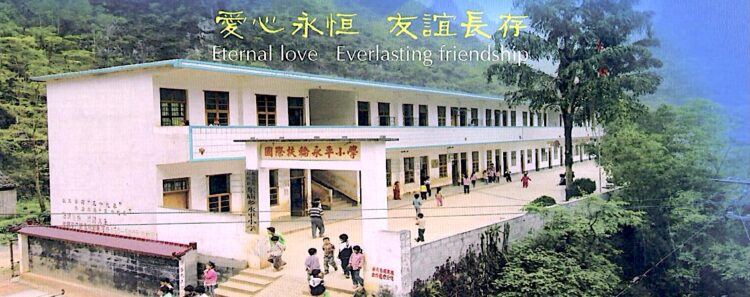
For ten years, the teaching buildings funded by the Rotary Club of Kowloon North and the Rotary Club of Macau have stood among the mountains, adding bright scenery to the Yao region and creating beautiful learning environments for students. Du’an Ethnic Experimental Middle School’s facilities reached a modern standard through the continuation of its comprehensive teaching building, construction of the science and technology laboratory building, construction of student dormitories, expansion and renovation of the canteen and older teaching buildings, filling of the school’s waste pond, construction of playgrounds and sports fields, and improvement of the campus environment. These projects fundamentally improved school conditions, raised teaching quality, and laid a strong foundation for the school to become well regarded.
The seven supported primary schools were not only given teaching buildings, but also teacher and student dormitories, playgrounds, walls, water tanks, school gates, toilets, desks, and chairs. They became among the best-equipped village schools in Du’an and were praised by the local government, teachers, students, and the public. In recent years, more than 80 percent of graduates of Du’an Ethnic Experimental Middle School have advanced to higher-level schools, and the school has been repeatedly recognized as an advanced unit at autonomous-region and city levels. The enrollment, graduation, and advancement rates of the seven primary schools have also risen significantly. Through acts of love, the two Rotary Clubs have built an eternal monument to ethnic education in the Yao mountains.
Key facilities and events included:
The new gate of Du’an Ethnic Experimental Middle School
The Rotary Science and Technology Building
The teaching complex
Benter Hall student dormitory
The student canteen
A beautiful campus environment
The completion ceremony of Phase II of the Ethnic Experimental Middle School project
The unveiling of the Rotary Science and Technology Building
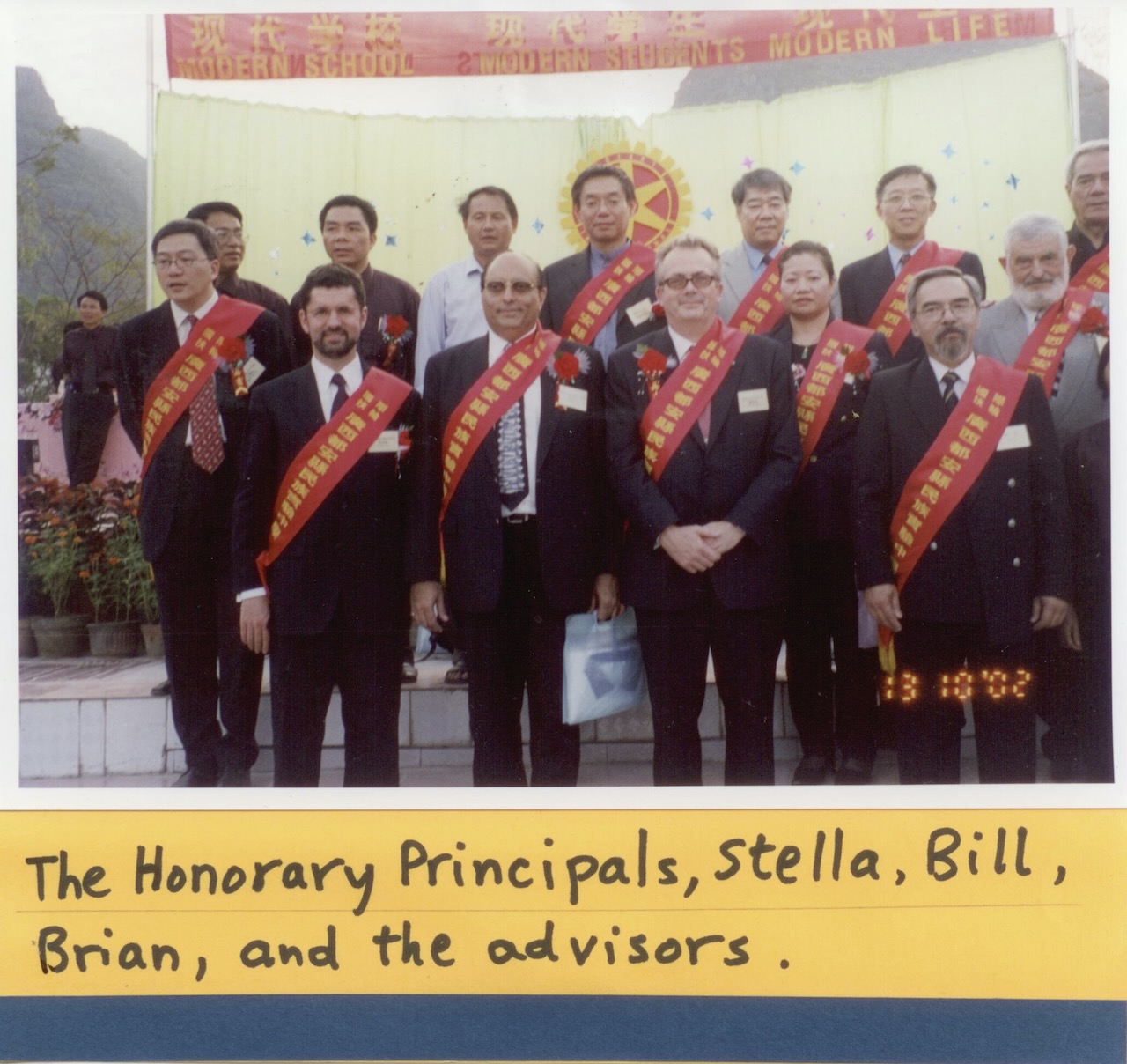
Recognition of Rotarians as honorary principals and consultants
Students of minority groups presenting embroidered balls and souvenirs to Rotary guests
President Nic Robinson meeting and signing autographs for students
The Ethnic Experimental Middle School received many honours for improvements in teaching conditions and teaching quality, including recognition as an outstanding junior secondary school in Hechi City for education and teaching quality, a successful education research experimental school, and a research base for English teaching in basic education.
The supported primary schools included:
International Rotary Longyan Primary School
International Rotary Longzhong Primary School
International Rotary Yongping Primary School
International Rotary Feng Shaolian Jianqiao Primary School
International Rotary Banlie Primary School
International Rotary Yanma Primary School
International Rotary Hualai Primary School
Completion ceremonies were held for Longyan, Banlie, Yongping, Yanma, Jianqiao, Longzhong, and Hualai Primary Schools. Teachers and students welcomed Rotary guests, and students began studying in spacious, bright new classrooms. Facilities included libraries, sports fields, and water tanks.
Du’an leaders presented banners of thanks to Rev. Lan Qinwen and Mrs. Lan Liang Zhiling for their assistance, and to Rotary representatives for their educational support.
Other Rotary-related projects in Du’an included:
Shanglü Rotary Primary School in Lalie Township, sponsored by the Rotary Club of Happy Valley
Shangjie Rotary Primary School in Sannong Township, sponsored by the Rotary Club of Happy Valley
Xingli Rotary Primary School in Sannong Township, sponsored by the Rotary Club of Guia, Macau
The Rotary Club of Kowloon North and the Rotary Club of Macau cared deeply for students in the Yao mountains and supported their growth in many ways. Over ten years, beyond funding school buildings and facilities, they organized teaching exchanges, study visits, and “hand-in-hand” activities to broaden students’ horizons, increase their knowledge, and support their physical and mental well-being.
They helped Du’an Ethnic Experimental Middle School establish multimedia classrooms, donated books to supported schools, created scholarships for the Ethnic Experimental Middle School, assisted hundreds of primary and secondary students and 25 poor university students, supplied desks and chairs to some supported schools, and built water tanks. They also provided vision and dental checks for primary and secondary students and county kindergarten children, taught eye-care and oral-health knowledge, and built a clinic for the county kindergarten.
Activities included:
Mayor Wei Shaoshi attending the 2009 New Year celebration with the Rotaract Club of Macau at the Ethnic Experimental Middle School
Rotarians joining the completion celebration evening
Rotaract Club of Macau members interacting with students
Du’an officials visiting Wong Chor Biu Secondary School in Hong Kong and Pui Ching Middle School in Macau
Rotarians conducting English conversation activities with students
Students attending computer classes in the Rotary-supported computer classroom
Health checks and oral-health education provided with the Macau Dental Association and the Optometry Centre of Hong Kong Polytechnic University
Rotaract Club of Macau donating scholarships, stationery, sports goods, books, desks, and chairs
The Rotary Club of Macau donating stationery and sports goods to Hualai Primary School
Rotarians sponsoring poor primary school students
Mr. Bill Benter presenting scholarships to students of the Ethnic Experimental Middle School
Twenty-five poor university students receiving support from Rotarians
Media reports in Wen Wei Po and Macau Daily covered Rotary’s poverty-relief and education-support work in Du’an. On 6 September 2007, the Du’an County Party Committee and People’s Government presented commemorative plaques to the Rotary Club of Kowloon North, the Rotary Club of Macau, the Rotary Club of Happy Valley, the Rotary Club of Guia, Rev. Lan Qinwen, Jian Peiwen, the Boys’ and Girls’ Clubs Association of Hong Kong, and Bill Benter for their support of Du’an’s “Two Basics” campaign.
The plaques read in substance:
“Supporting Du’an’s ‘Two Basics’ campaign:
Love nourishes the ‘Two Basics’ and cultivates students;
Hearts are with the Yao mountains and nurture future pillars of society.”
Conclusion
Over the past ten years, the Rotary Club of Kowloon North and the Rotary Club of Macau have donated funds to support ethnic education in Du’an County. Their work has produced significant results, drawn positive social response, and had far-reaching influence.
The work had several notable features. First, many donors were highly respected figures, including entrepreneurs, bankers, and prominent community members. Second, donors came from a wide range of backgrounds, including compatriots from Hong Kong and Macau, friends from Japan, India, Europe, and America, and overseas Chinese. Third, the amount donated was large, exceeding RMB 10 million in total, including RMB 5 million for the Ethnic Experimental Middle School alone. Fourth, the supported projects were fully equipped. Fifth, the support lasted for a long period, from 1999 to 2009. Sixth, the donors showed admirable dedication: successive presidents and members of the two Rotary Clubs had their own jobs, yet every time they came to Du’an for inspections, groundbreakings, and completion ceremonies, they travelled after work or at weekends and returned to Hong Kong or Macau after the activities. Seventh, the supported projects produced excellent results and clear social benefits.
The Rotary Clubs of Hong Kong and Macau endured hardship to develop ethnic education in Du’an and devoted themselves to the healthy growth of Yao mountain students. Their spirit is admirable and their generosity noble. On the tenth anniversary of the Rotary Club of Kowloon North and the Rotary Club of Macau supporting ethnic education in Du’an, governments at all levels in Du’an, together with teachers, students, and residents, sincerely wish all Rotary presidents and members good health, success in all things, and happiness for their families.
May Rotary’s merits remain with the Yao mountains and shine with the sun and moon.

Editorial Committee
Advisers: Huang Hanying, Wei Shaoshi, Pan Baojing, Jian Peiwen, Bill Benter
Chief Editors: Wu Huijun, Li Wei
Editors: Wei Huande, Huang Jixian, Lu Bingxiang, Tang Meng, Pan Zhipeng
Editorial Members: Pan Rijie, Liang Renguo, Tang Hongsheng, Huang Shanning, Lan Zhibiao, Wei Jinkui, Yuan Fengmei, Wei Jiawen, Lan Shuguang, Mo Xiantao, Meng Zhiguo, Luo Xianqiang, Tan Yunhe
Executive Editors: Wei Huande, Lu Bingxiang, Pan Zhipeng, Mo Xiantao
Contributors: Wei Huande, Huang Jixian, Tang Meng
Photographers: Pan Zhipeng, Mo Xiantao
Design: Mo Xiantao